What XPENG's Australian Service Network Looks Like in 2026
The service question is answered by two published facts: roadside assistance runs for 7 years from first registration, and scheduled maintenance falls every 12 months or 20,000 km, whichever comes first. Support is now provided directly by XPENG ANZ, remote diagnostics are standard, and the owner tools sit on the XPENG Australia site.

Key takeaways
- Roadside assistance is published at 7 years from first registration, on 1800 255 494.
- Scheduled maintenance runs every 12 months or 20,000 km, whichever comes first.
- Remote diagnostics are standard, and can sometimes resolve an issue without a workshop visit.
- The 2026 strategy news flags advanced Navigation Guided Pilot for 2027 and five new models in 2026.
Who supports the car now
The ownership page is unambiguous about the chain of responsibility: vehicles imported into Australia through the manufacturer's own Australian operation and registered here are covered by the published terms, and support is handled directly by XPENG ANZ. That last point matters for anyone who bought during the earlier distribution phase, because the site's own FAQ directs existing TrueEV customers to XPENG ANZ support. In practice, most owners never need to think about the corporate structure; they need a phone number, a booking path and a dealer within reach, and those are published.
Roadside assistance for seven years
Seven years of roadside cover from first registration is unusually long, and it is worth understanding what it covers before you need it. The published contact number is 1800 255 494, with 24/7 coverage across the majority of Australia, which is the sort of line item that looks like marketing until the day a tyre lets go on a highway shoulder 200 km from the nearest town. Read the term as calendar-based rather than distance-based: it starts at first registration and runs for seven years regardless of how far you drive. Keep the number saved in the car and in the Owner's App, and check the roadside assistance terms for the conditions, because roadside programs always define what counts as a covered event.
Remote diagnostics as a standard feature
Remote diagnostics are published as standard rather than as an optional extra, and the site notes that they can sometimes resolve an issue remotely. The practical value is a diagnosis before the car goes anywhere: instead of describing a noise to a service adviser over the phone, the vehicle's own data gives the workshop a starting point. When a fault does need attention, that shortens the visit and reduces the chance of leaving the car for a day while someone hunts for the cause. The Owner's App is the other half of the same idea, because it lets you schedule maintenance and services rather than keeping a mental calendar of dates and odometer readings.
Servicing on a 12-month or 20,000 km rhythm
Servicing is recommended through an XPENG Authorised Dealer on a schedule of every 12 months or 20,000 km, whichever comes first, with the detail held in the owner's handbook and the XPENG ANZ Warranty and Maintenance Manual for Australia. For a car driven 15,000 km a year that means one visit annually; for a car driven 30,000 km a year it means roughly every eight months. The published terms also cover spare parts and accessories, and Owner Connection support sits alongside them as the contact point when something needs escalation rather than a booking.
| Owner service | Published detail |
|---|---|
| Roadside assistance | 7 years from first registration, 1800 255 494, 24/7 across the majority of Australia |
| Scheduled maintenance | Every 12 months or 20,000 km, whichever comes first |
| Remote diagnostics | Standard, and can sometimes resolve issues remotely |
| Owner's App | Schedule maintenance and services from the app |
| Whole vehicle warranty | 7 years / unlimited km for private use |
What the 2026 announcements add
The manufacturer's Australian news page fills in the direction of travel. On 21 July 2026 the X9 launched in Australia in Melbourne, alongside a stated strategy that includes advanced Navigation Guided Pilot in 2027, five new models in 2026, and a growing sales and service network. The wider company news is a useful signal for service planning rather than a specification: Q2 2026 results published on 25 August 2026 show a gross margin of 20.7% and overseas markets contributing 25% of first-half revenue, and the robotics business raised over US$900 million at a post-money valuation of over US$6.3 billion in the same month. A brand investing at that scale is a brand that intends to keep servicing the cars it sells here, which is the only version of this argument a buyer should care about.
Parts, accessories and the small annoyances
Service support is not only about major repairs. The published owner services include spare parts and accessories, which matters more than it sounds when a car is new to a market: a replacement wiper, a floor mat set or a towbar that fits properly are the items that decide whether ownership feels settled or improvised. The Owner's App handles the scheduling side, and Owner Connection gives an escalation path when something needs a person rather than a form. If you are ordering an accessory, ask whether it is a dealer-fitted item and whether fitting affects the published warranty terms, because that question is much easier to answer before installation than afterwards. Keep the paperwork for anything added to the car, since a full history helps at resale and settles any question about what was fitted and when.
Worked example: a 1,000 km drive, planned around the stops
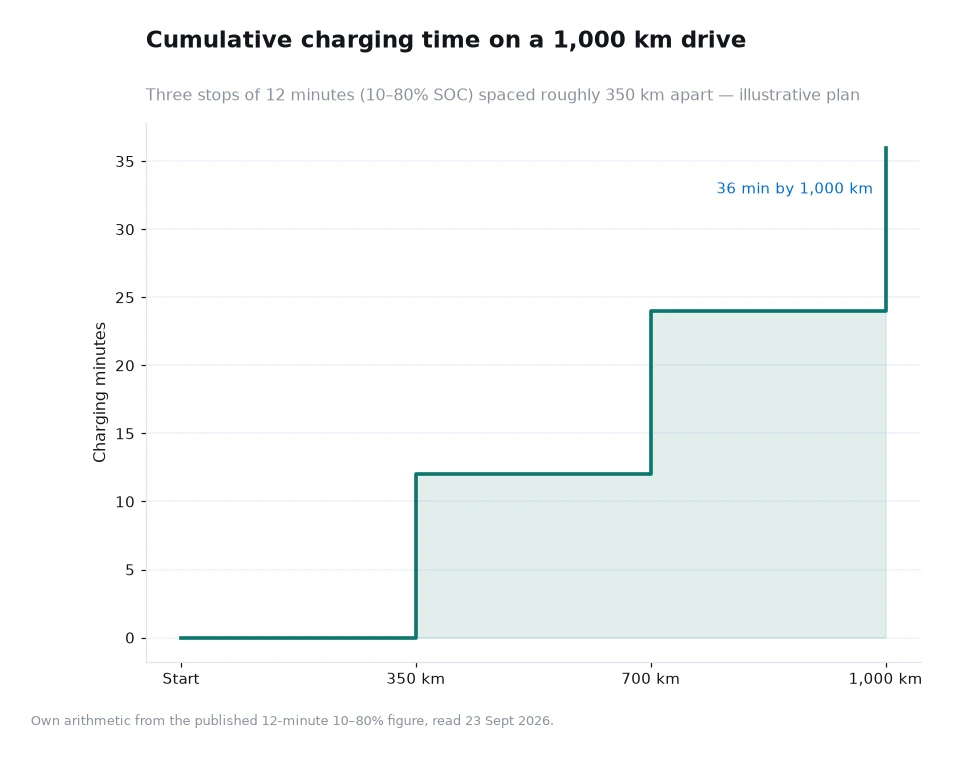
This is an illustrative plan built from a published figure, with every assumption stated. Assume a 1,000 km drive, stops spaced roughly 350 km apart, and a rapid charger that takes the car from 10% to 80% state of charge in the published 12 minutes. Three stops cover it: 3 x 12 = 36 minutes of charging in total. Charging minutes accumulate as 0 at the start, 12 by the 350 km mark, 24 by 700 km and 36 at 1,000 km, which is exactly what the chart below plots. Add driving at an assumed average of 100 km/h, so 1,000 / 100 = 10 hours in motion, and the day becomes 10 hours plus 36 minutes, or roughly 10.6 hours door to door. Halve the number of stops and you cannot cover the distance on the same battery; double them and you add 36 minutes for no benefit.
Frequently asked questions
Who provides warranty and service support for an XPENG in Australia?
Support is provided directly by XPENG ANZ, and the published warranty applies to vehicles imported into Australia through the manufacturer's own Australian operation and registered here. The site's FAQ also points customers who bought through TrueEV to XPENG ANZ support, so the contact path is the same either way.
How often does the car need to go to a dealer?
The published schedule is every 12 months or 20,000 km, whichever comes first, and servicing is recommended through an XPENG Authorised Dealer. Whichever trigger arrives first sets the visit, so a low-kilometre car is booked annually while a high-kilometre car may be booked more often.
How to prepare for your first service
Save the roadside number, set the maintenance reminder in the Owner's App, and keep a note of anything the remote diagnostics have flagged, because a described symptom plus stored data is a far shorter workshop visit than a described symptom alone. If the car is due on distance rather than date, book before the odometer passes 20,000 km rather than after. Ten minutes of preparation now saves a rearranged day later, and it keeps the service history tidy for whoever owns the car after you. Use Find a Dealer to confirm the authorised workshop nearest to you before you need it, not after.
Roadside assistance terms, service intervals and owner-app features quoted here are as published on the manufacturer's Australian website and read on 23 Sept 2026, along with the dated news items summarised above. The charging plan in the worked example is my illustrative arithmetic from the published 12-minute figure, not manufacturer data. [1]